
Arnold Resident Lookup Records and Limits
Arnold is an unincorporated community inside Anne Arundel County. The custodians are county and state offices, not a city clerk. Each record answers a narrow question, so pick the source that fits yours. A parcel card names an owner or entity and may show a premises field. A court index gives a case party and a filing date. A voter search confirms registration once the required fields are entered. Estate and vital records can support family or historical questions. None forms a complete roster. A single hit never proves someone lives at an Arnold address.
| Record | What it can confirm | Where | Access |
|---|---|---|---|
| Parcel and land record | Tax-record owner or entity, premises, deed reference, recorded party role | SDAT and MDLandRec | Public search; current remote land-record terms apply |
| Voter confirmation | Current registration or polling route when a valid search succeeds | Maryland Voter Lookup | Required identifying inputs; protected fields remain withheld |
| Court summary | Case number, party role, court, type, status, and filing date | Maryland Judiciary Case Search | Free summary; full file is held by the court clerk |
| Estate case | Decedent, estate number, representative, status, and date clues | Maryland Estate Search | Online search; copy route and older coverage vary |
| Vital record | Eligible event or index information | Maryland VSA and State Archives | Age, entitlement, fee, and copy rules apply |
Good searches begin with precise keys. Use a complete street address for parcel questions, a case number when one is known, or a full name paired with an independent date or address clue. The SDAT Real Property Search and MDLandRec are separate systems, so keep the tax-record role and the recorded-instrument role distinct. Do not merge them.
Arnold Court Search Fields
Maryland Judiciary Case Search covers Anne Arundel Circuit and District Court summaries. It pulls them together in one state portal. Its public form accepts party type, first name, and last name. It also takes court system, case type, county, and a filing-date range. First name is optional. Partial names work with a percent sign after the first character or characters. A large result set should be trimmed. Use a date, first name, court, or case type to narrow it. A matching name is not an identity conclusion. Compare party role, court, case number, date, and an independent Arnold record first. Only then treat the result as a lead.
| Search inputs | Party type, first and last name, court system, case type, county, and filing-date range. |
|---|---|
| Result row | Case number, name, month and year of birth where displayed, party type, court, case type, status, filing date, and caption. |
| Case detail | Party roles, filing events, hearing dates, disposition, and any public docket material. |
| Full file | Request in person or in writing from the clerk where the case was filed, using the case number and desired document. |
The Maryland Judiciary Case Search returns summaries only. Anne Arundel Circuit civil coverage begins in 1991 and criminal coverage in 1989, per the FAQ; District civil begins in 1989, criminal in late 1991, and some older material sits in a history database. Protected files stay closed. Sealed, shielded, expunged, juvenile, and adoption records are not a gap to work around.
Arnold Name Matches Need Two Keys
Same-name hits are common in Arnold records. Two independent discriminators should anchor any match. A full name plus a dated street address works well. A deed book and page also pairs well with a name. An estate or case number works too. A middle initial, a suffix, or a shared ZIP can narrow the field. Yet none of these settles anything on its own. Role labels deserve respect too. A grantor, grantee, trustee, personal representative, attorney, claimant, plaintiff, defendant, voter, or licensee is not automatically an Arnold resident. A careful Arnold resident lookup leaves conflicts visible rather than merging several same-name hits into one profile.
Documentation matters as much as matching. For each source, write down the exact spelling. Also record the agency or collection, the record date, the access date, the jurisdiction, the place or address exactly as shown, the role, and any public identifier. Add a note for every unresolved conflict. A deed from one year stays a separate time-stamped observation. A voter result from another does too. So does an obituary from a third. Arnold's Census labels, county-community tags, precinct names, ZIP codes, and postal designations overlap constantly without ever matching. Preserve the label the source itself supplies.
Note: A missing result may reflect spelling, a date range, protected data, portal coverage, or pending updates. So it counts as weak negative evidence.
Arnold Voter Lookup Requires Precise Inputs
Maryland's State Board of Elections offers a Voter Lookup. It is not a historical name directory. Users must supply a first name, last name, date of birth, and a five-digit ZIP. Street number and middle initial stay optional. The state updates its data daily. Yet a new or changed submission can take up to three weeks to appear.
Failed searches have many innocent causes. An exact-name difference, a former name, a prior ZIP after a move, a pending update, inactive status, or address protection can all hide a valid record. Never disclose a date of birth, full address, party, or participation history obtained this way. Use the Maryland Voter Lookup only for its permitted purpose. Voter-list copies follow a different legal route. Maryland law requires a written application and a sworn statement for electoral use. Protected or Safe at Home information stays restricted. Public inspection does not turn the system into a general Arnold resident list.
Arnold Estate Search for an Heir
An estate trail can carry an Arnold residents-directory question a long way. Maryland Estate Search returns public fields. These include the decedent name, estate number, date of death, personal representative, attorney, county, estate type, and status. Any of those can open a door. A result might point to a Register of Wills file or an obituary. It might also point to a deed recorded by a representative or heir. It still does not prove that a same-name person ever lived at an Arnold parcel. Search the estate number first. Compare dates and role labels carefully. When the connection matters, inspect the underlying filing or deed before drawing conclusions.
Begin at Maryland Estate Search and keep the estate number handy for any file request. The Anne Arundel Register of Wills handles local estate administration. Online coverage spans all counties from 1998 forward, while older automation varies by county.
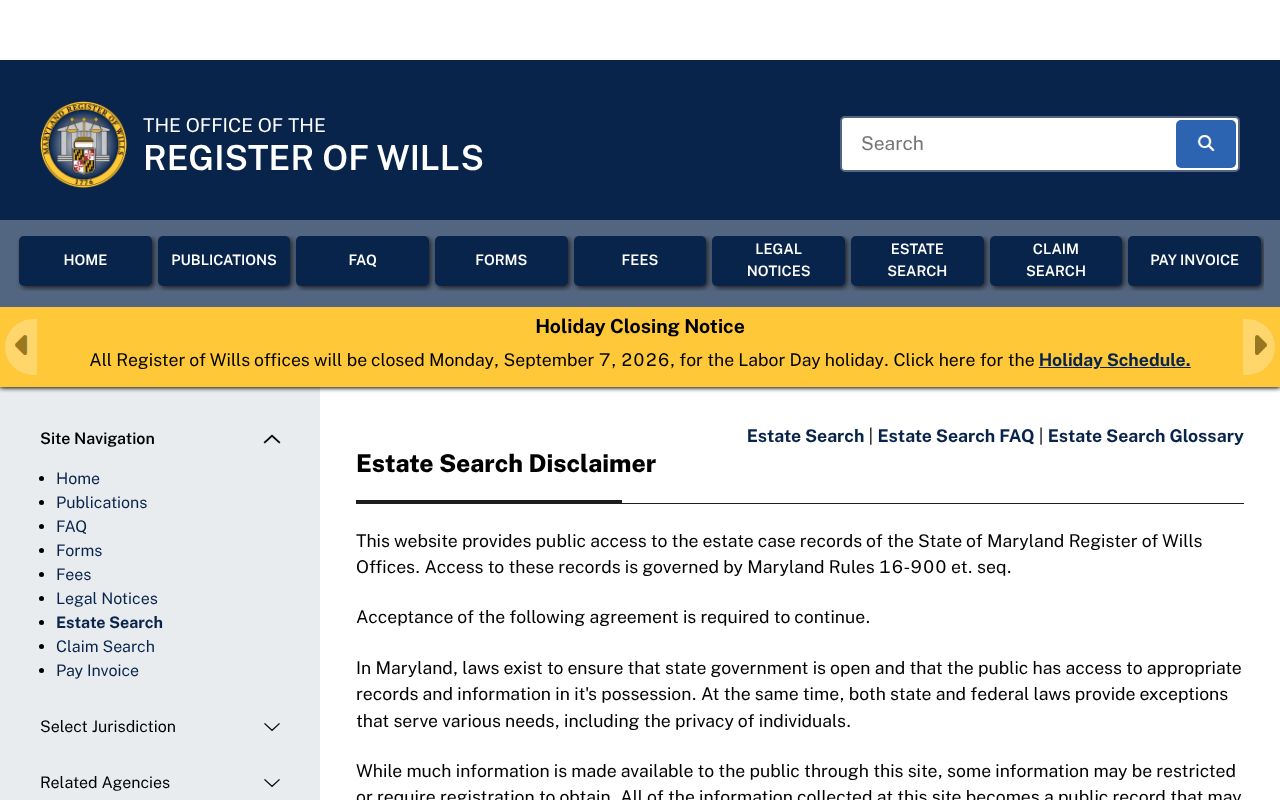
Treat an estate result as a starting record, not a conclusion. An heir or probate trail in the Arnold residents directory still needs support. Pair the entry with the actual estate file, a dated address clue, or a deed reference before tying it to an Arnold person or property.
Arnold Vital Records Rules
Maryland vital records carry age and eligibility boundaries. Birth records stay restricted for 100 years. Death records stay restricted for 10 years under State Government §9-1015. Birth records past 100 years sit in unrestricted categories. Death records past 10 years, marriage licenses, and absolute divorce or annulment records do too. All are subject to the relevant copy procedures. The Maryland Department of Health VSA supplies current certified products. Anne Arundel's local health office offers an eligible appointment route. The Maryland State Archives holds older series and indexes. A certificate is evidence for the eligible requester. It is not a shortcut to a present address claim in an Arnold resident lookup.
Use the Maryland Vital Records route for current product instructions. Use the Maryland State Archives vital-record guide for historical access. VSA lists mail, local-office, and online order channels. The current application controls the ID, relationship, entitlement, fee, and delivery requirements.
Arnold Records-Request Fallback
Sometimes an index names the exact record but the document itself is not online. A focused Maryland Public Information Act request is the right fallback. The governing law sits at General Provisions §§4-101 through 4-601. A well-drawn request can support an Arnold resident lookup. Name the existing record, subject, address, case or account number, date window, and the electronic format you want. Custodians do not have to create new reports. They do not have to compile new databases, answer broad life-history questions, or override another record system's access rules.
The Maryland Attorney General PIA FAQ explains statewide access principles. For a county record, the Anne Arundel MPIA portal provides the topic and requestor fields. The county states acknowledgement within ten business days. A response then follows no later than thirty days, subject to statutory conditions and complexity. Ask for a fee estimate up front. Narrow the request if the quote runs high.
Verifying an Arnold Resident Lookup
Good verification moves from one known fact toward a second record that answers a different question. Start with a current parcel clue. Locate the premises and account in SDAT, note the deed book and page, then inspect the recorded instrument in MDLandRec. For a name-based result, add a court, estate, vital, or historical source only after the first record supplies an independent date, role, or address detail. That discipline keeps an Arnold resident lookup anchored. Verification, not assertion, is the goal.
- Write down the exact name, date, address, case, estate, or parcel fact already supported by a source.
- Search the record system that uses a different identifier, such as a deed reference after an SDAT result or an estate number after an obituary clue.
- Compare spelling, date, place, and role. Flag a conflict instead of forcing a match.
- Request a clerk, archive, health, or records-custodian copy only when the precise document is needed.
- Save the source link, record date, access date, and the limitation that remains.
- Docket
- The court's chronological list of filings and events in a case.
- Index versus image
- An index points to a record; an image is the underlying document or scan and may have separate access rules.
- Certified copy
- A copy issued by the custodian with official certification when the record type and requester qualify.
Arnold Lookup Legal Limits
An Arnold resident lookup must respect restricted records. Some records are redacted, sealed, or shielded, and others sit behind a confidentiality program. Maryland Safe at Home supplies substitute-address and mail-forwarding service for eligible survivors and threatened individuals. Never infer an actual address from a substitute address, a tax mailing field, or a voter result. The same caution applies to a land record or a newspaper. A lookup grants no right to reconstruct a protected location. Motor-vehicle records are private. Court, police, and vital records carry their own access rules. If a government record is wrong, contact the custodian. Ask about its correction, redaction, or confidentiality procedure.
The Maryland Safe at Home program is the official confidentiality route. Its protections are never invitations to reconstruct a protected location. The absence of any result is not one either.
Lawful use. Use Arnold records for lawful personal research, family history, estate matters, or civic verification. Do not use any result to stalk, harass, intimidate, or harm another person.